
Flux
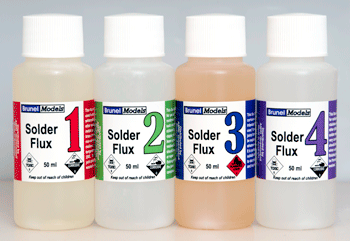

Used to solder whitemetal and other non-ferrous metals. It will leave a non corrosive residue at temperatures above 250C. The finished joint should be washed or wiped.
Suitable for use with non-freeous metals such as brass, nickel-silver, copper, etc. It will leave corrosive residues that should be washed or wiped thoroughly when the joint is completed.
A non-corrosive flux intended for to be used for soldering joints that cannot be washed. It is not as active as Flux 1 and 2.
Used for soldering stainless steel and other difficult to solder metals. It is very corrosive. Care should be taken when using it. The finished joint should be thoroughly washed.
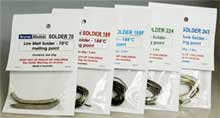
This solder is ideally suited for detailing (adding small parts to an already completed structure that has been soldered together with a solder of a higher melting point).
Ideal for the construction of etched kits and joining sheet metal.
This solder contains a non-corrosive flux and can be used for the construction of etched kits and joining sheet metal. It can also be used for elctrical and electronic soldering.
This solder is suited for normal soldering of etched kits and sheet metal but is particularly suited for soldering brass and filling gaps.
This is particulary suited to constructing modules that will later be incorporated into a larger assemply. When soldering these modules into a larger assembly a lower melting point solder should be used (such as 188C).
This solder is no longer available.
| Code | Description | Price A$ |
| BMF1 | BMF1 Solder Flux 1 | $6.80 |
| BMF2 | BMF2 Solder Flux 2 | $5.80 |
| BMF3 | BMF3 Solder Flux 3 | $6.50 |
| BMF4 | BMF4 Solder Flux 4 | $9.40 |
Note that Flux 1 and 3 are no longer available from our supplier. These fluxes will be discontinued when stocks are sold out.
| Code | Description | Price A$ |
| SOL145 | 145 degree solder | $6.75 |
| SOL188 | 188 degree solder | $5.00 |
| SOL188F | 188 degree solder + flux | $6.50 |
| SOL224 | 224 degree solder | $4.75 |
| SOL243 | 243 degree solder | $6.50 |
| SOL070 | 70 degree solder - NO LONGER AVAILABLE | NA |
Note that the melting point specified for solder is the point at which it first starts to melt. Normally a higher temperature is required to cause it to flow appropriately for the soldering being undertaken.